Explore Pasadena Neighborhood Styles and Architecture
July 2, 2026
July 2, 2026
If you are drawn to Pasadena, chances are you are not just looking for a house. You are looking for a street, a setting, and a style that feels right the moment you arrive. In a city known for architectural depth, that choice can feel exciting and a little overwhelming at the same time. This guide will help you understand how Pasadena’s neighborhoods differ in character, what architectural patterns shape each area, and how to compare them with more clarity. Let’s dive in.
Pasadena is widely recognized by the city as a center of architecture in Southern California. Its residential areas reflect several major growth periods, from late 19th-century estates to early 20th-century Craftsman neighborhoods, 1920s revival districts, and postwar ranch and modern development.
That history matters because Pasadena’s neighborhood identity is rarely about one home style alone. In many areas, the overall feel comes from the mix of lot size, street trees, setbacks, retaining walls, and building type. Two neighborhoods may both feature Craftsman homes, yet feel completely different once you see how the streetscape and scale come together.
The city also maintains a preservation program with a searchable historic resources database, citywide design review, and historic-district design guidelines for designated properties. For you as a buyer or homeowner, that means architectural character in Pasadena is often supported by an active framework, not just local tradition.
A simple way to compare Pasadena is to think in three broad categories:
There is also another feature that shapes the city’s personality: the bungalow court. Pasadena is especially known for this low-density courtyard housing type, where smaller individual units are arranged around shared open space. It is part of what gives older parts of the city a layered residential character.
Across many neighborhoods, mature trees, Arroyo-stone retaining walls, and generous setbacks do as much to define the experience as the houses themselves. If you are comparing areas, it helps to look beyond the facade and notice how the street feels from front yard to front yard.
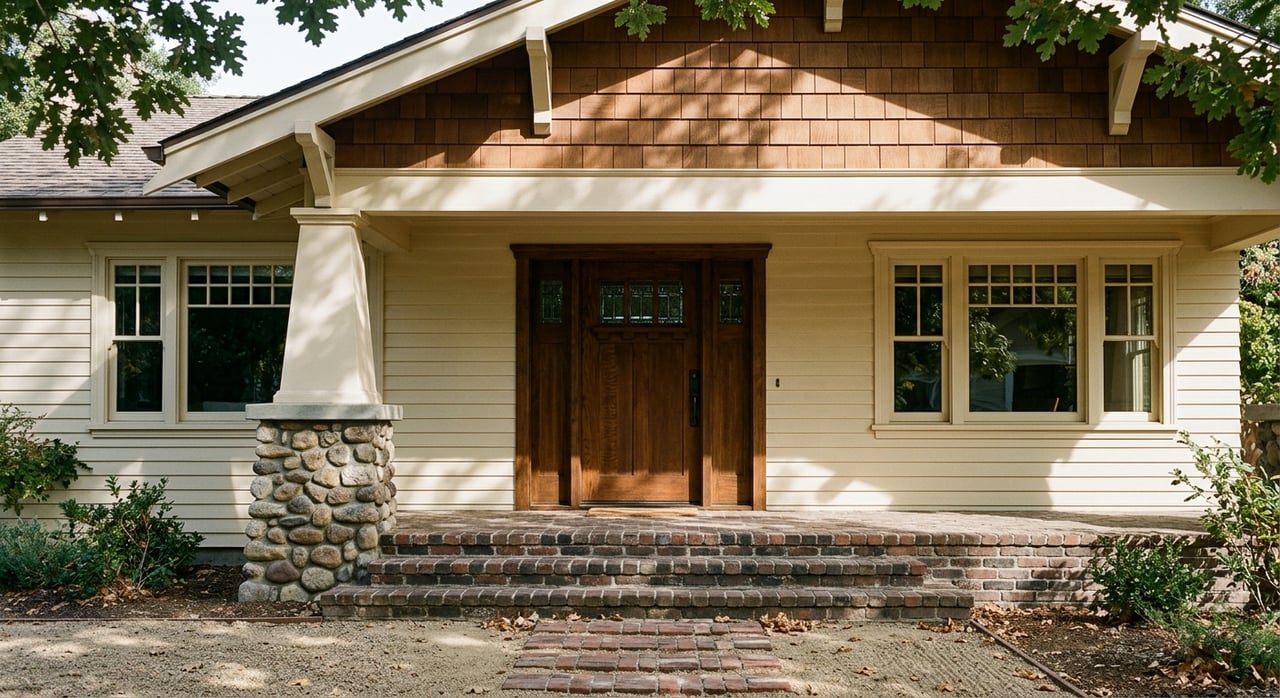
Bungalow Heaven is one of Pasadena’s best-known concentrations of California Craftsman bungalows. The district is bounded by Orange Grove Boulevard, Mentor, Washington Boulevard, and Chester, and its streets rise gently north to south toward the foothills.
The area is defined by low-scale bungalow forms, wood detailing, and regional materials such as California redwood and Arroyo stone. Just as important, the neighborhood has a strong canopy of street trees that reinforces its cohesive look.
If you are looking for an early 20th-century neighborhood with a consistent rhythm, Bungalow Heaven offers one of Pasadena’s clearest examples. It feels unified, porch-oriented, and visually connected from block to block.
Orange Heights offers another strong Craftsman-era experience, but with a different setting. Roughly bounded by North Los Robles, North El Molino, Jackson, and Mountain, the district is described by the city as largely unchanged, with about 80 percent contributing buildings.
While Craftsman homes define much of the area, you will also find Prairie-influenced, transitional, Period Revival, and even an early California Ranch example. That variety gives the neighborhood more architectural range while still preserving a clear historic identity.
The streetscape is a major part of the appeal here. Elevated lots, mountain views, landscaped setbacks, Arroyo-stone retaining walls, and closely spaced mature trees all contribute to a more layered and elevated feel.
Garfield Heights is a single-family district where Craftsman houses are the dominant presence. There are also smaller numbers of Queen Anne and later Period Revival homes, which adds some visual contrast without changing the overall impression.
City guidance points to detached rear garages and river-rock retaining walls as character-defining features. If you appreciate neighborhoods where details beyond the house itself help tell the story, Garfield Heights is a strong example.
Madison Heights is one of Pasadena’s oldest residential areas and is often noted for its walkable setting. Subdivided in 1905, it includes an eclectic mix of Craftsman, Spanish, Colonial, and other traditional home styles.
Its central location near the Pasadena Playhouse, Caltech, Pasadena City College, the Langham Huntington Hotel, and South Lake dining and retail gives it a different kind of appeal. Architecturally, it feels less uniform than a pure bungalow tract, but that mix is part of its character.
South Orange Grove Boulevard has one of Pasadena’s most storied architectural legacies. In the 1890s, it was known as Millionaires Row, developed on former orange-grove land with substantial homes that reflected the wealth and ambition of the period.
The city describes a broad architectural mix here, including Richardsonian Romanesque, Queen Anne, Prairie, American Foursquare, Shingle, Craftsman, and more modest Folk Victorian and vernacular cottages. That range gives the boulevard a sense of architectural richness rather than one uniform style.
The Ross Grove Landmark District contains the largest remaining grouping of original South Orange Grove homes still in existence. The Wrigley Tournament House also helps preserve the sense of scale and setting associated with the original boulevard.
Oak Knoll developed with estate-size lots intended for custom homes. Pasadena Heritage describes it as a subdivision planned to rival Orange Grove and the West Side, which helps explain its more expansive residential pattern.
Within Oak Knoll, the Hillcrest area includes mansions and large Craftsman homes, among them the Freeman House and Greene & Greene’s Culbertson House and Blacker House. In practical terms, this is the kind of neighborhood where lot size, mature canopy, and custom architecture work together to create a more formal and estate-like feeling.
The city also identifies Oak Knoll and Madison Heights as two of Pasadena’s oldest and most beautiful neighborhoods, both known for walkability and a strong tree canopy. For you, that means Oak Knoll may offer a rare blend of larger residential scale and an established neighborhood setting.
On the west side of the Arroyo Seco, Linda Vista and nearby San Rafael developed later than central Pasadena and held onto a more open, country-like setting for longer. The city notes that San Rafael Heights and Linda Vista were annexed in 1914, after the Colorado Street Bridge helped connect them more closely to Pasadena.
This later development pattern helps explain why the area can feel different from the denser historic neighborhoods closer to the center of the city. The land, spacing, and later home types create a more open residential experience.
Pegfair Estates adds another layer to this story. The district includes ranch-style development as well as an earlier 1930 Colonial Revival mansion known as Pegfair, and the area was listed in the National Register in 2010.
The neighborhood includes Traditional, Modern, and Contemporary ranch houses, some with restrained Asian influences and integrated landscaping. If you are drawn to postwar design but still want a setting with historic depth, this area stands out.
Hastings Ranch is Pasadena’s only large-scale, comprehensive postwar subdivision. The city describes it as two neighborhoods: Lower Hastings, with about 600 homes built between 1948 and 1954, and Upper Hastings, with about 800 homes built in the 1950s.
Upper Hastings Ranch was developed in 1951 by Coronet Homes, with houses designed by Edward Fickett for veteran buyers. These homes emphasized indoor-outdoor living, one-story plans, attached garages, and modern conveniences.
That makes Hastings Ranch very different from Pasadena’s earlier bungalow and estate districts. Instead of front-porch rhythm and detached rear garages, you see a more horizontal, suburban postwar pattern shaped by convenience and lifestyle.
The city also notes later Hastings Ranch Riviera tracts with terraced lots and a mix of Modern, Ranch, and Oriental model homes. Even within one broader area, there can be real variation in how the postwar period shows up on the ground.
Pasadena’s modern architecture is not limited to tract homes. According to the city’s mid-century modern tour, some of the area’s most interesting modern houses sit on hillside sites and other challenging lots.
Those conditions encouraged architect-driven International and Modern designs by figures such as Buff & Hensman, Harwell Hamilton Harris, and John Lautner. For you as a buyer, that distinction matters.
A postwar ranch neighborhood and a hillside modern enclave may have been built in roughly the same broad era, but they offer very different experiences. One leans toward subdivision planning and everyday convenience, while the other often reflects site-specific design and stronger architectural experimentation.
In Pasadena, preservation status can shape day-to-day neighborhood character. In designated districts, exterior changes are influenced by the city’s design review process and historic-district guidelines.
That does not just affect architecture on paper. It can influence how blocks evolve over time, how consistent streetscapes remain, and how original materials or design features are treated.
If you are comparing homes in Pasadena, it is wise to consider not only the style you love, but also the setting and review context that come with it. In many cases, the lived experience of a neighborhood is closely tied to that long-term stewardship.
If you are deciding where to focus, start with the feeling you want day to day. A compact Craftsman district, an estate street with deeper setbacks, and a postwar ranch neighborhood may all be beautiful, but they support very different lifestyles and visual preferences.
You may want:
The key is to compare neighborhoods as complete environments, not just collections of houses. In Pasadena, the street, lot, setback, landscape, and architectural period all work together.
If you are exploring Pasadena and want a thoughtful, discreet perspective on where your style and goals may fit best, Brianna Deutsch offers tailored guidance with the calm, polished representation this kind of search deserves.
Stay up to date on the latest real estate trends.
Whether acquiring a landmark estate or preparing to present your property to the global market, Brianna Deutsch provides the expertise, loyalty, and discretion required to navigate Beverly Hills real estate at the highest level.